Chart patterns are recognizable formations created by price movements on a chart. Traders use them to anticipate potential continuations or reversals in trend. While no pattern guarantees an outcome, understanding what each formation typically signals is a valuable analytical skill.
Reversal Patterns
Head and Shoulders
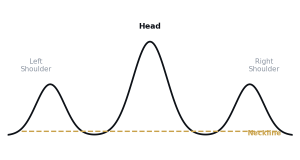
This pattern consists of three peaks — a higher central peak (head) flanked by two lower peaks (shoulders). It typically signals a reversal from an uptrend to a downtrend. The inverse version signals a reversal from a downtrend to an uptrend.
Double Top and Double Bottom
A double top forms when price reaches a similar high twice, unable to break through, signaling a potential bearish reversal. A double bottom is the mirror image, signaling a potential bullish reversal.
Continuation Patterns
Flags and Pennants
These short-term consolidation patterns typically appear after a strong price move and suggest the prior trend is likely to continue once the pattern completes.
Triangles
- Ascending triangle — flat resistance with rising support, often bullish
- Descending triangle — flat support with falling resistance, often bearish
- Symmetrical triangle — converging support and resistance, direction depends on breakout
RISK NOTE: Chart patterns are probabilistic tools, not guarantees. Always confirm with volume and other indicators before acting.
Trading Chart Patterns Responsibly
- Wait for confirmed breakouts rather than anticipating them
- Use volume to validate the strength of a breakout
- Set stop-losses beyond the pattern’s structure
- Combine patterns with broader trend and market context
Read More: Technical Analysis Basics: Support, Resistance, and Trendlines
Risk Warning: CFDs and forex trading are complex instruments and come with a high risk of losing money rapidly due to leverage. You should consider whether you understand how these products work and whether you can afford to take the high risk of losing your money. Past performance is not indicative of future results. This article is for educational purposes only and does not constitute investment advice.