Candlestick charts are the most widely used chart type in trading, offering a visual representation of price action that reveals not just where price moved, but the psychology behind the move. Understanding key candlestick patterns can help traders spot potential reversals and continuations.
Anatomy of a Candlestick
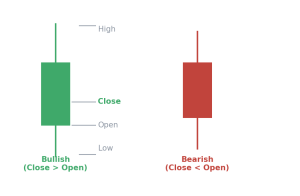
Each candlestick shows four data points for a given period: the open, high, low, and close. The ‘body’ represents the range between open and close, while the ‘wicks’ (or shadows) show the high and low extremes.
Single-Candle Patterns
- Doji — open and close are nearly equal, signaling indecision
- Hammer — a small body with a long lower wick, often signaling a bullish reversal after a downtrend
- Shooting Star — a small body with a long upper wick, often signaling a bearish reversal after an uptrend.
- Marubozu — a candle with little to no wick, indicating strong directional conviction
Multi-Candle Patterns
- Bullish/Bearish Engulfing — a candle whose body fully ‘engulfs’ the previous candle’s body, signaling a potential reversal
- Morning Star — a three-candle bullish reversal pattern appearing after a downtrend
- Evening Star — a three-candle bearish reversal pattern appearing after an uptrend
- Three White Soldiers / Three Black Crows — three consecutive strong candles signaling trend continuation or reversal
KEY TAKEAWAY: Candlestick patterns are most reliable when they appear at key support/resistance levels and are confirmed by subsequent price action.
Using Candlesticks in Your Trading
Candlestick patterns should rarely be used in isolation. Combining them with trend analysis, support/resistance, and volume gives a more complete picture and helps filter out false signals.
Read More: Popular Chart Patterns and What They Signal
Risk Warning: CFDs and forex trading are complex instruments and come with a high risk of losing money rapidly due to leverage. You should consider whether you understand how these products work and whether you can afford to take the high risk of losing your money. Past performance is not indicative of future results. This article is for educational purposes only and does not constitute investment advice.